What does “ready” mean at each step, and does everyone actually agree?
Senior Design Program Manager | Experience readiness operating model
THE PROBLEM
The product organization shipped quickly across web, iOS, and Android. Production wasn't the constraint. With a mature design system, rebuilding a screen was fast. The friction showed up in the handoffs.
“Ready” meant something different depending on who you asked. A designer's "ready to hand off," a PM's "ready to build," and an engineer's "ready to ship" weren't the same state, and nothing named the difference. Every handoff quietly renegotiated expectations, and some of the work got done twice.
THE APPROACH
I started by looking for where shared understanding was breaking down rather than where work was moving slowly. Teams can move quickly through a process they understand; they lose time when every handoff requires renegotiating expectations.
So the answer wasn't more process. It was enough shared structure to reduce ambiguity without slowing teams down. It connected design-system usage to that structure, so adoption had a place in the design system work instead of being a separate ask.
THE FRAMEWORK
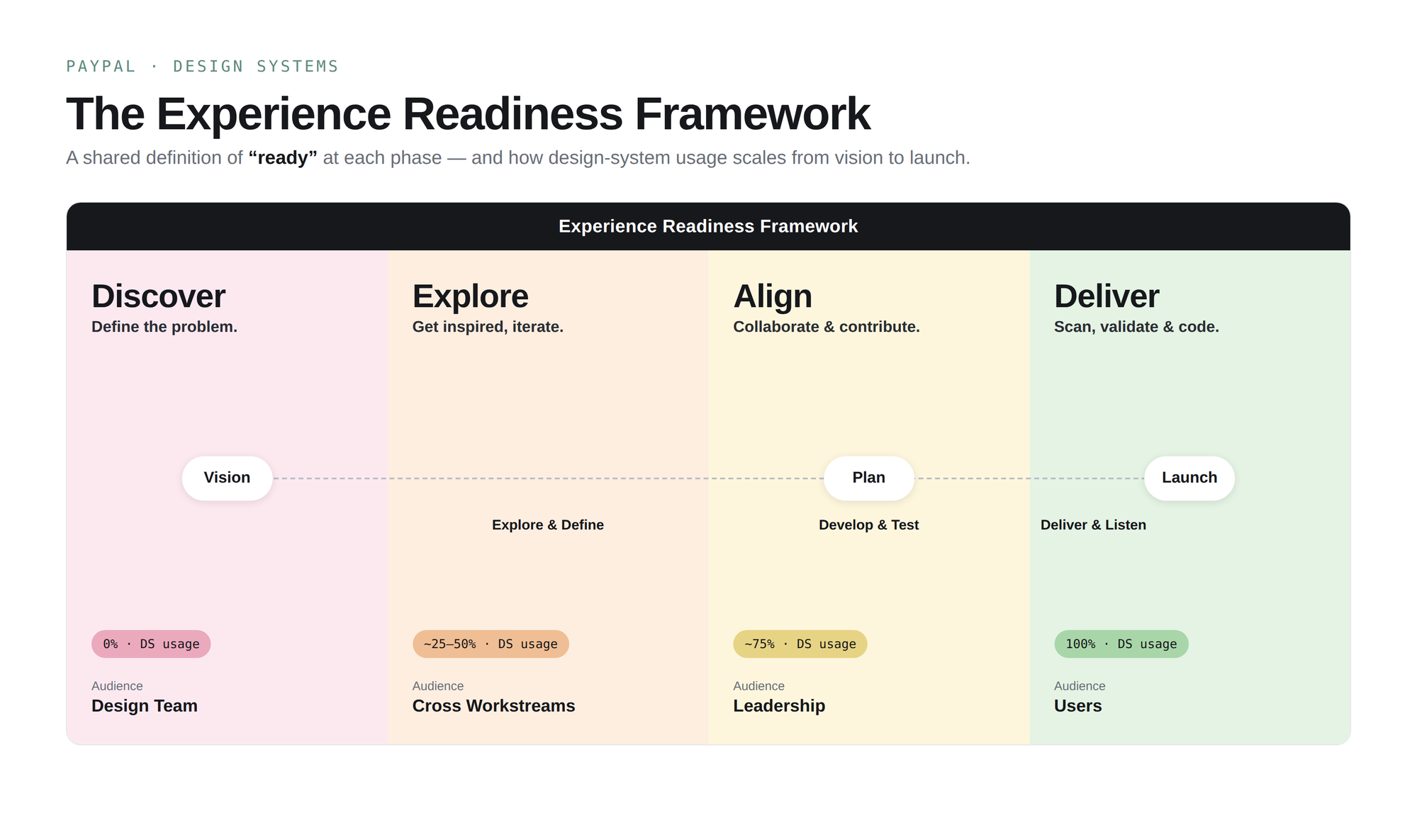
Developed in partnership with the Design Systems Director. Four phases, each with a purpose, the roles involved, and what "ready" looked like for Experience Design before work moved on.
The framework translated an abstract idea into an operating model teams could use every day. That translation was the work.
A shared definition of "ready," phase by phase
01 Discover
Define the problem. What has to be true before exploration starts.
02 Explore
Get inspired, iterate. What signals it has converged enough to align.
03 Align
Collaborate and contribute. Commit to a direction, surface constraints.
04 Deliver
Scan, validate, code. What "ready to build" and "ready to ship" require.
THE KEY DECISIONS
The goal wasn’t to add another approval process. The organization already moved quickly, and I didn’t want the framework to become something teams had to work around. Instead, I focused on creating enough shared understanding that Design, Product, and Engineering could make consistent decisions without formal gates at every step.
That meant defining what “ready” looked like at each phase while leaving room for teams to scale the level of rigor to the complexity of the work. The framework created a common language for handoffs rather than another layer of process.
WHAT CHANGED
✓ A shared definition of “ready” gave Design, Product, and Engineering a common expectation at each phase instead of three different interpretations.
✓ Readiness expectations scaled with the complexity of the work rather than applying the same level of rigor to every project.
✓ Handoffs started from a shared understanding of what was complete instead of renegotiating expectations each time.
✓ Design-system expectations, including content, motion, accessibility, and quality checks, became part of the delivery process rather than a separate adoption effort.
✓ Roles and responsibilities were explicit at each phase, making ownership clearer across Design, Product, and Engineering.
Anonymized from a large fintech design organization. Internal terminology and implementation details have been generalized.