❋ Point-of-View
I’ve been thinking about what happens to the traditional DesignOps “hub” now that we have AI.
Before, we organized information around a place people had to visit.
Now, the information can stay where it is and we can bring the right pieces to the person who needs them.
For years, part of my job was figuring out how a design organization keeps track of how it works. Ways of working, onboarding, templates, processes, decisions, team information, governance, historical context - all the things people need but don’t necessarily think about until they can’t find them.
The answer was usually some version of a hub.
A lot of that lived in Confluence, with links out to Figma, Jira, decks, research, shared files, and wherever else the actual work happened.
And a surprising amount of the work was simply figuring out what belonged where.
That’s the part AI doesn’t really change.
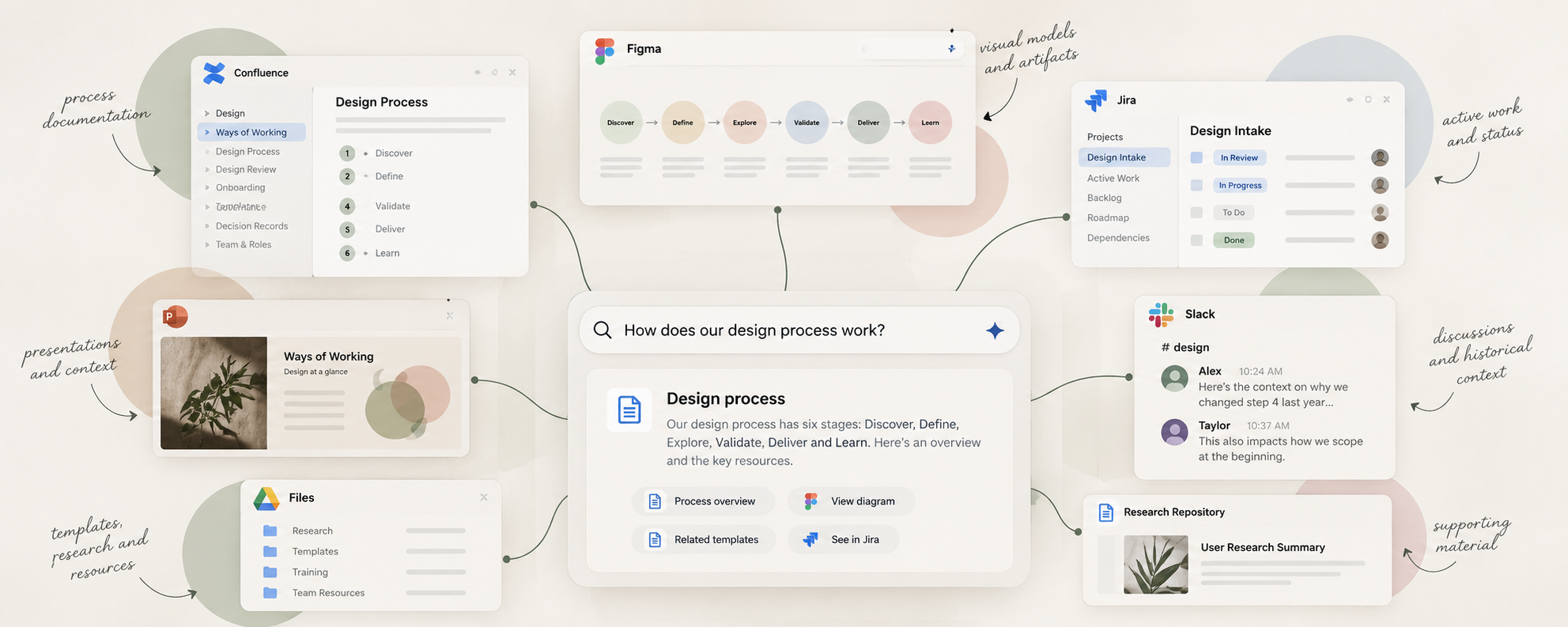
Say we have a Ways of Working deck that explains the design process. The actual process diagram was created in Figma. The written explanation lives in Confluence. Jira reflects how work is actually moving. And somewhere in Slack is a conversation about why we changed one part of the process six months ago.
All of that information is potentially useful.
But it doesn’t all mean the same thing.
The Confluence page might be the current source of truth. Figma might own the visual. The deck tells the story we used when we rolled it out. Slack provides context. Jira tells us what’s happening now.
Before AI, I needed to make that understandable to a person.
Where do I go? What do I read? Is this still current? Where’s the template? Who owns this? Why do we do it this way?
So we built navigation, landing pages, indexes, links, onboarding paths, naming conventions, archives, and all the other things that made a hub usable.
AI gives us another way into the same information.
Instead of knowing that the answer is under Design > Ways of Working > Design Process, someone can just ask:
“What’s our design process?”
Or:
“I’m a new PM. What do I need to know about working with Design?”
That’s a much better experience.
But only if the information underneath it is good.
If AI finds three versions of the design process and can’t tell which one is current, we’ve just made it faster to get the wrong answer.
So I’m finding myself thinking less about “Where should we put all of our documentation?” and more about questions like:
What is the source of truth?
Who owns it?
What’s current and what’s historical?
Which things are reference material versus working documents?
How are they connected?
If two sources disagree, which one should we trust?
That’s really not that different from the Design Ops work I’ve been doing all along.
What’s different is what we can do with it.
Confluence can still hold the durable organizational knowledge. Figma can hold the design artifacts and diagrams. Jira can tell us what’s happening with the work. Presentations can tell a story for a particular audience. Slack can provide useful context.
We don’t necessarily need to move all of that information into one place.
We need to understand how it fits together.
Then AI can do something genuinely useful: find the right pieces, understand which ones matter most, and get someone to an answer without making them understand our entire information architecture first.
That’s the part that feels exciting to me.
And this isn’t limited to documentation.
The same questions are starting to show up in the work itself. A designer might have a design in Figma and a working prototype built in Cursor or another AI coding tool. Which one is the handoff artifact? If the interaction changes in the prototype, does Figma need to be updated? Is the prototype exploratory, or is Engineering expected to build from it?
AI makes it much easier to create new kinds of artifacts. That makes it even more important to be clear about what each artifact is for, who owns it, and which one is authoritative.
That’s the part of this shift I find most interesting. The tools are changing quickly, but the underlying Design Ops questions are pretty familiar:
What is this?
Where does it belong?
Who owns it?
How does it connect to everything else?
And what should someone trust?
For years, I was designing these systems so people could find their way through them.
Now AI can help people move through them faster - and create new things along the way.
The hub didn’t really go away.
The front door changed.